
You leave the optician with a new eyeglass prescription in your hand.
Then you look at it.
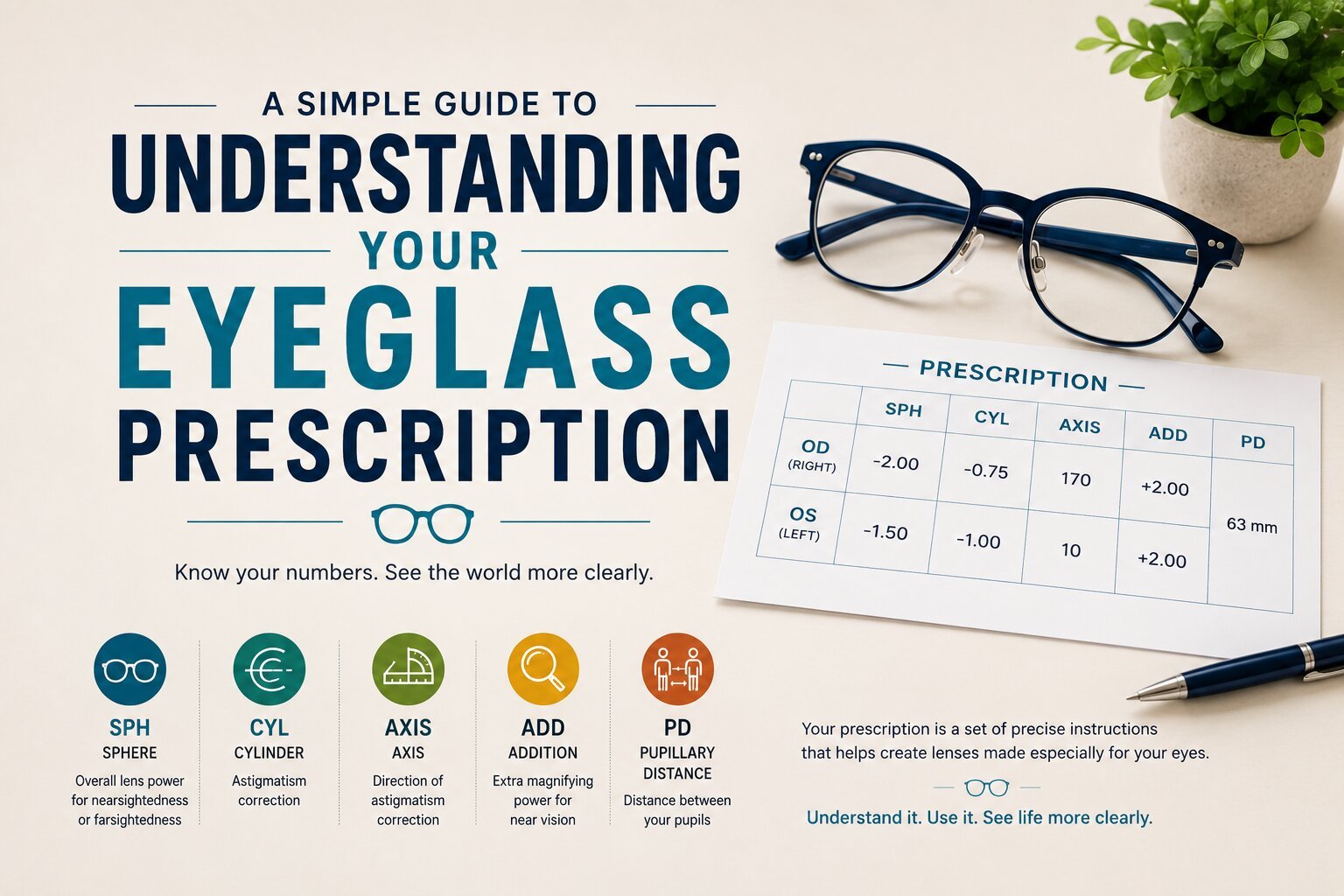
SPH. CYL. AXIS. ADD. PD.
Plus signs. Minus signs. Numbers like -2.00, +1.25, and 175.
For something designed to help you see more clearly, an eyeglass prescription can look surprisingly confusing.
The good news is that you do not need to be an optometrist to understand the basics. Once you know what the abbreviations mean, your prescription starts to tell a fairly simple story about your vision.
Here is how to read it.
First: Your Right Eye and Left Eye
Most prescriptions provide separate measurements for each eye because the two eyes do not necessarily require the same correction.
You may see:
OD — Right eye
OS — Left eye
These abbreviations come from Latin: oculus dexter and oculus sinister.
You may also see OU, meaning both eyes.
Some prescriptions make things even easier by simply using R for right and L for left.
Now let's look at the numbers.
SPH — Sphere
SPH, or Sphere, indicates the basic amount of lens power required to correct nearsightedness or farsightedness.
The number is measured in diopters (D).
For example:
-2.00 SPH
The minus sign generally indicates myopia, or nearsightedness. You can see nearby objects relatively well, while objects farther away become blurry.
A prescription such as:
+2.00 SPH
generally indicates hyperopia, or farsightedness, where additional focusing power is needed.
As a general rule, the farther the number is from zero, the greater the amount of optical correction required.
So -4.00 represents stronger lens power than -1.00.
But SPH is only part of the story.
CYL — Cylinder
If you have astigmatism, your prescription may contain a number under CYL, short for Cylinder.
Astigmatism occurs when the eye's focusing system is not equally curved in all directions, causing light to focus unevenly.
A prescription might look like:
SPH: -2.00
CYL: -1.25
The CYL value tells the lens manufacturer how much additional correction is required for the astigmatism.
If the CYL field is blank, your prescription may not require cylindrical correction.
And whenever there is a CYL value, you will normally find another number beside it.
That's the Axis.
AXIS — The Direction of Astigmatism Correction
The Axis works together with CYL.
Unlike SPH and CYL, Axis is not a measure of lens power. It describes the orientation of the astigmatism correction.
It is expressed as a number between:
1 and 180 degrees.
For example:
CYL: -1.25
AXIS: 175
This does not mean that an Axis of 175 is "worse" than an Axis of 90.
It simply identifies the direction in which the cylindrical correction needs to be positioned.
Think of CYL as telling the optician how much astigmatism correction is required and Axis as telling them where that correction should be oriented.
ADD — Additional Power for Near Vision
If you wear bifocals, progressive lenses, or certain reading prescriptions, you may see ADD on your prescription.
ADD stands for Addition.
It represents extra magnifying power added to the distance prescription to assist with near vision.
For example:
ADD: +2.00
This is commonly associated with presbyopia, the age-related reduction in the eye's ability to focus comfortably on nearby objects.
Presbyopia is a normal part of aging and is one reason many people eventually need reading glasses, bifocals, or progressive lenses.
PD — Pupillary Distance
PD, or Pupillary Distance, is different from SPH, CYL, and ADD because it does not describe the strength of your prescription.
Instead, it is a measurement, usually expressed in millimetres.
PD measures the distance between your pupils—or, in a monocular measurement, from the center of your nose to each pupil.
Why does that matter?
Because the optical centres of your lenses need to be positioned correctly in relation to your eyes.
You might see:
PD: 63 mm
or separate measurements such as:
Right: 31 mm
Left: 32 mm
PD becomes particularly important when glasses are being ordered online because the person manufacturing the lenses cannot physically measure your face.
What About Prism?
Some prescriptions contain Prism and Base measurements.
Prism correction is used in certain cases where the eyes need help working together or aligning images properly.
A prism prescription may include a numerical amount along with a direction such as:
Base Up
Base Down
Base In
Base Out
This is more specialized than an ordinary SPH/CYL prescription.
If your prescription contains prism correction, it is particularly important to have the glasses made according to the exact instructions provided by your eye-care professional.
Let's Read a Sample Prescription
Imagine your prescription says:
| SPH | CYL | AXIS | |
|---|---|---|---|
| Right (OD) | -2.00 | -0.75 | 170 |
| Left (OS) | -1.50 | -1.00 | 10 |
In simple terms:
Both eyes require correction for nearsightedness because the SPH values are negative.
Both eyes also have astigmatism correction, represented by the CYL values.
The Axis numbers specify the orientation of that correction for each eye.
Notice that the prescription is different between the two eyes.
That's completely normal.
Is a Bigger Number Always a "Worse" Prescription?
Not exactly.
It is tempting to look at prescription numbers as a score for how "bad" your eyesight is, but vision is more complicated than that.
SPH, CYL, Axis, ADD, prism, visual acuity, eye health, focusing ability, and other factors describe different aspects of vision.
For example, an Axis of 180 isn't inherently worse than an Axis of 20. And two people with similar SPH values may still experience their vision differently.
Your prescription is better understood as a set of instructions for making your lenses, rather than a grade for your eyesight.
Eyeglass and Contact Lens Prescriptions Are Not the Same
This is an important distinction.
If you already have an eyeglass prescription, do not assume you can simply use the same numbers to buy contact lenses.
Contact lenses sit directly on the eye, while eyeglass lenses sit some distance in front of it. Contact-lens fitting also involves additional measurements and considerations, including lens curvature and diameter.
Use the prescription intended for the product you are buying.
Don't Guess Your Prescription
Understanding your numbers is useful.
Changing them yourself isn't.
If your current glasses no longer feel right, you experience frequent headaches or eye strain, or your vision has noticeably changed, the solution is not to experiment with stronger or weaker lenses.
Have your eyes professionally examined.
An eye examination does more than determine what lens power gives you clearer vision; it can also assess aspects of your overall eye health.
Your Prescription Is Simpler Than It Looks
The next time you see a prescription full of abbreviations and numbers, remember:
SPH = basic lens power
CYL = amount of astigmatism correction
AXIS = orientation of that correction
ADD = additional near-vision power
PD = positioning measurement for your lenses
Prism = specialized correction for certain binocular-vision needs
Once those pieces make sense, the mysterious collection of numbers becomes much easier to understand.
Your prescription is essentially a set of precise instructions telling an optical laboratory how to build lenses specifically for your eyes.
And that small piece of paper?
It is the blueprint behind clearer vision.