
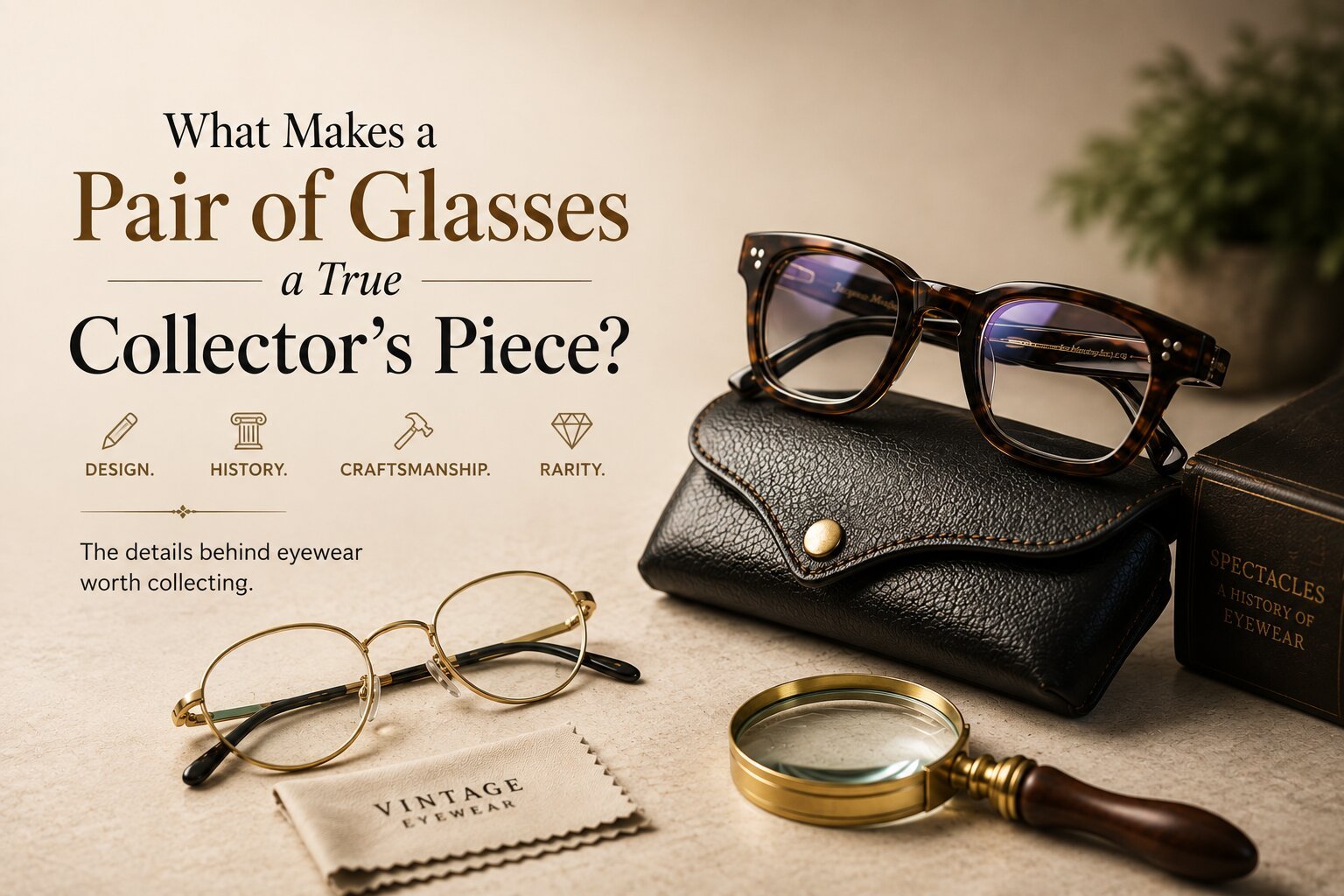
Some glasses help you see better. Some complete an outfit. And then there are those rare frames that become something else entirely — objects worth collecting.
To a collector, eyewear is more than acetate, metal, hinges, and lenses. A remarkable frame can represent an era, a designer’s philosophy, an unusual manufacturing technique, or a moment in fashion history. The right pair can remain desirable decades after trends have moved on.
So, what actually separates collectible eyewear from an ordinary pair of glasses?
1. A Design You Can Recognize Without Seeing the Logo
The strongest collectible frames have an identity of their own.
Think of an unusual bridge, dramatic proportions, sculpted temples, distinctive lens geometry, or a silhouette that immediately feels different from mass-produced eyewear. Great design does not rely entirely on a logo to tell you that the frame is special.
Collectors are often drawn to pieces that capture a particular design language while still looking remarkable years later.
When the frame itself becomes the signature, you are looking at something interesting.
2. Rarity Changes Everything
Scarcity is one of the forces behind almost every collectible market, and eyewear is no exception.
Limited editions, discontinued models, small production runs, unusual colourways, vintage releases, and hard-to-find collaborations can become particularly attractive to collectors.
A frame that was once sitting unnoticed in an optical shop may become difficult to obtain years later simply because production stopped and surviving examples gradually disappeared into private collections.
But rarity alone does not create greatness.
A rare frame with little aesthetic or historical significance is simply rare. The most desirable pieces combine scarcity with design, craftsmanship, provenance, or cultural importance.
3. Craftsmanship You Can Feel
Pick up a beautifully manufactured pair of glasses and there is often an immediate difference.
The finish feels deliberate. The hinges operate smoothly. The acetate has depth. The metalwork feels precise. Small details that might be invisible from across the room become fascinating when examined closely.
Collectors notice these things.
Hand-finishing, unusual materials, complex construction, engraving, distinctive hardware, and traditional manufacturing techniques can all contribute to a frame's appeal.
In collectible eyewear, the details aren't secondary.
The details are often the reason to collect.
4. The Story Behind the Frame Matters
Collectors rarely collect objects alone.
They collect stories.
Perhaps a frame represents an important period in a designer's career. Maybe it came from a celebrated collaboration. Perhaps the model became associated with a particular cultural movement, film, musician, artist, or era.
Even an unusual production history can transform the way collectors see a piece.
That context gives an object meaning beyond its physical construction.
Two visually similar frames may therefore have completely different collector appeal because one has a compelling history behind it and the other does not.
5. Condition Can Make or Break a Collectible
With older eyewear, finding the model is only half the challenge.
Finding it in exceptional condition is another matter.
Collectors generally pay close attention to scratches, oxidation, damaged hinges, warped temples, missing components, replaced parts, faded markings, and excessive restoration.
Original accessories can also matter. Depending on the piece, an original case, packaging, documentation, cleaning cloth, or other accompanying material can make an already desirable frame more complete.
This is particularly important with vintage and discontinued eyewear, where pristine examples naturally become harder to find over time.
6. Provenance Adds Another Layer
For significant pieces, where the glasses came from can matter almost as much as what they are.
Original receipts, certificates, archival material, serial information, documented ownership, or other evidence of authenticity can strengthen a frame's provenance.
This becomes increasingly important as the desirability — and value — of a particular designer or model increases.
Collectors aren't simply asking:
"Is this genuine?"
They may also be asking:
"What is the history of this particular example?"
7. Cultural Significance Can Turn Eyewear Into an Icon
Some frames escape the eyewear world entirely and become part of popular culture.
A distinctive pair worn by an influential artist, musician, actor, designer, or public figure can become permanently associated with an aesthetic or period.
Other designs become significant because they challenged what eyewear was supposed to look like.
That cultural relevance can transform glasses from fashion accessories into recognizable pieces of design history.
8. Age Doesn't Automatically Mean Collectible
One of the biggest misconceptions is that old equals valuable.
It doesn't.
There are countless old frames with little collector demand, just as relatively recent limited-production designs can become highly sought after.
Age becomes meaningful when accompanied by something else:
rarity, craftsmanship, important design, provenance, condition, cultural significance, or historical relevance.
That's why knowledgeable collectors evaluate the entire story rather than simply checking the manufacturing date.
The Collector’s Eye
Perhaps the most interesting thing about collecting eyewear is that there is no single formula.
One collector may pursue pristine vintage frames from a particular decade. Another may collect experimental Japanese designs. Someone else may search exclusively for discontinued luxury models, unusual materials, iconic silhouettes, or obscure independent designers.
And sometimes the most treasured pair isn't the most expensive one.
It's the frame that took three years to find.
The discontinued colour that almost never appears for sale.
The model connected to a particular moment in design history.
The pair whose craftsmanship becomes more impressive every time you examine it.
That is when eyewear stops being merely functional.
A true collector's piece doesn't simply sit on your face. It carries a story — of design, craftsmanship, culture, and time.
And for the right collector, finding that story is half the pleasure.