
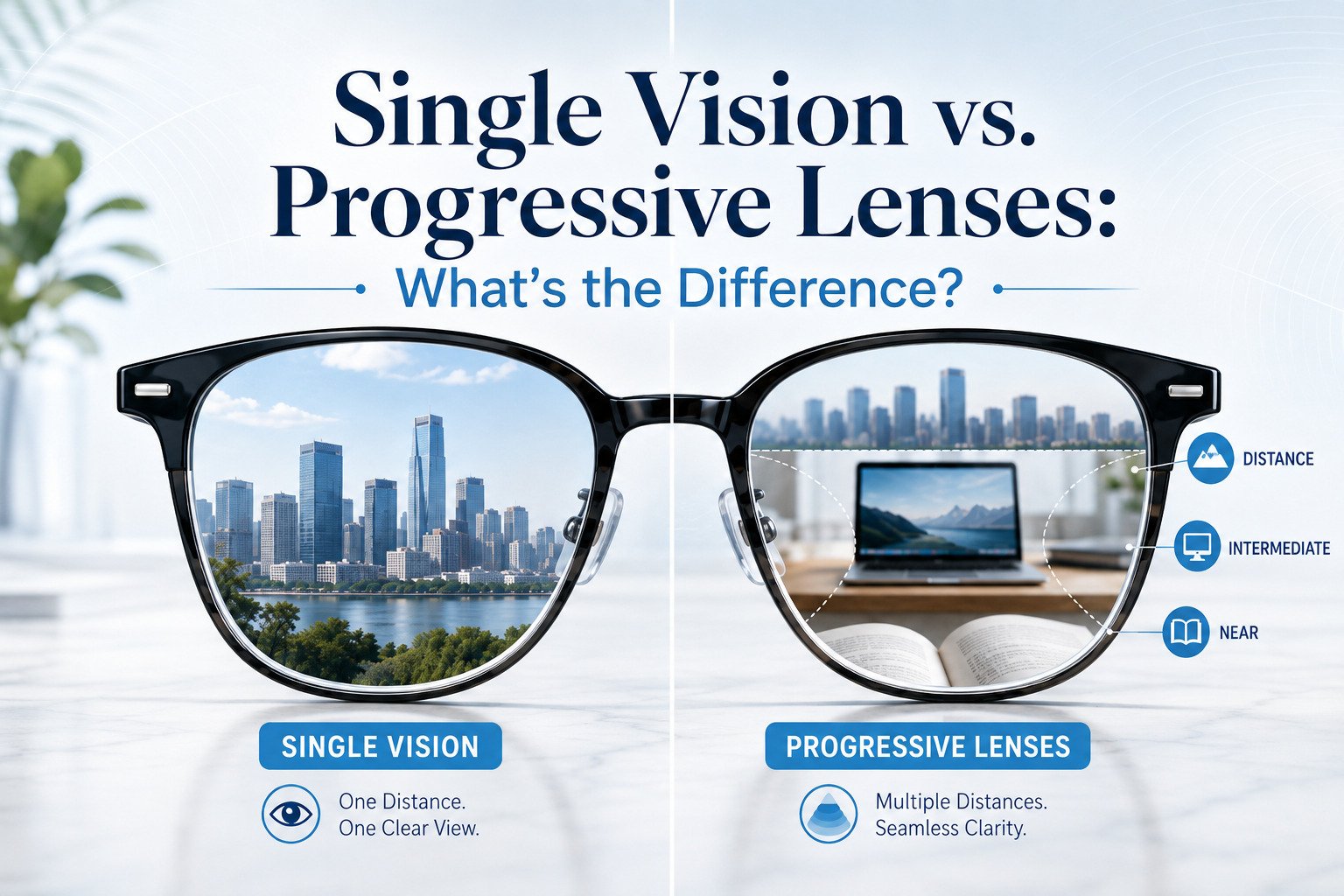
Choosing the right eyeglass lenses can make a major difference in how clearly and comfortably you see throughout the day. Two of the most common lens options are single vision lenses and progressive lenses, but they are designed for very different visual needs.
If you are unsure which type is right for you, understanding how each lens works can make your decision much easier.
What Are Single Vision Lenses?
Single vision lenses have one prescription across the entire lens surface. They are designed to correct vision at one specific distance.
Depending on your eyesight, single vision lenses may be prescribed for:
Distance vision, such as driving, watching television, or seeing objects clearly across a room
Near vision, such as reading, sewing, or using a smartphone
Intermediate vision, such as working on a desktop computer
Because the prescription remains consistent throughout the lens, single vision glasses are generally easy to adapt to and provide a wide, clear field of vision for their intended distance.
Who Are Single Vision Lenses Best For?
Single vision lenses are commonly recommended for people with myopia, hyperopia, or astigmatism who only require correction at one distance.
They may also be ideal for people who prefer separate pairs of glasses for different activities. For example, someone may keep one pair for driving and another specifically for reading or computer work.
Single vision lenses are also commonly used by younger people who have not yet developed presbyopia.
What Are Progressive Lenses?
Progressive lenses are multifocal lenses that provide several vision zones within one pair of glasses.
Instead of offering only one prescription, progressive lenses gradually transition between different viewing distances.
The upper part of the lens is generally used for distance vision.
The middle section helps with intermediate vision, such as viewing a computer screen or dashboard.
The lower section is designed for close-up activities such as reading a book or checking your phone.
The transition between these areas is smooth, meaning progressive lenses do not have the visible lines commonly associated with traditional bifocal or trifocal lenses.
Why Do People Need Progressive Lenses?
As we age, the natural lens inside the eye gradually becomes less flexible. This makes it harder to focus on objects that are close to us.
This age-related condition is known as presbyopia and commonly becomes noticeable around the age of 40 or later.
You may notice yourself:
Holding your phone farther away to read
Struggling with small print
Needing more light when reading
Experiencing eye strain during close-up tasks
Switching between distance glasses and reading glasses
Progressive lenses are designed to address these different visual requirements in a single pair of eyeglasses.
Single Vision vs. Progressive Lenses
The biggest difference between the two is the number of viewing distances each lens can correct.
Single vision lenses provide one prescription and are designed for one viewing distance.
Progressive lenses contain multiple prescription zones and allow you to see clearly at near, intermediate, and far distances.
Another major difference is adaptation.
Single vision lenses usually feel natural almost immediately because the entire lens contains the same prescription.
Progressive lenses can require an adjustment period because your eyes and brain need to learn which part of the lens to use for different distances.
For many wearers, this adjustment happens relatively quickly once they become familiar with the lenses.
Advantages of Single Vision Lenses
Single vision lenses remain one of the most popular choices because of their simplicity.
They provide:
A wide field of clear vision
Easy adaptation
Excellent clarity at the prescribed distance
A straightforward lens design
Options for distance, reading, or computer use
They may also be more economical than advanced multifocal lenses, depending on the lens material, coatings, and prescription.
Advantages of Progressive Lenses
The biggest advantage of progressive lenses is convenience.
Instead of constantly changing between reading glasses, computer glasses, and distance glasses, you can use one pair for most daily activities.
Progressive lenses also offer:
Distance, intermediate, and near correction in one lens
No visible bifocal line
A more modern appearance
Smooth transitions between viewing distances
Greater convenience for everyday activities
For someone who regularly drives, works on a computer, reads documents, and uses a smartphone, progressive lenses can be particularly useful.
Do Progressive Lenses Have Any Disadvantages?
Progressive lenses can take some time to get used to.
During the adjustment period, some people may initially notice mild distortion around the edges of the lenses or feel that they need to move their head slightly more when looking at certain objects.
Proper lens measurements and accurate frame fitting are extremely important with progressive lenses. The optical zones need to be positioned correctly in relation to your eyes.
This is why professional fitting is especially important when purchasing progressive eyewear.
Modern premium progressive lens designs can also provide wider and more comfortable viewing zones compared with older or basic designs.
Are Progressive Lenses the Same as Bifocals?
No.
Bifocal lenses usually contain two clearly separated prescription areas: one for distance and another for near vision. A visible line often separates the two sections.
Progressive lenses provide a gradual transition between distance, intermediate, and near vision without a visible dividing line.
This gives progressive lenses a more natural appearance and provides intermediate vision that traditional bifocals may not offer as effectively.
Which Lenses Are Better for Computer Work?
The answer depends on how you use your computer.
A person who spends many hours working at a fixed computer distance may benefit from dedicated single vision computer glasses.
Someone who moves frequently between a computer screen, documents, colleagues, and objects farther away may prefer progressive lenses.
There are also occupational and office progressive lenses designed specifically to provide larger intermediate and near viewing areas for people who spend significant amounts of time indoors or at a desk.
Which Option Should You Choose?
Single vision lenses may be the better choice if:
You only need correction for one distance
You are comfortable using separate reading glasses
You primarily need glasses for driving or distance vision
You want a simple and easy-to-adapt lens
Progressive lenses may be the better option if:
You need correction for both distance and near vision
You are developing presbyopia
You frequently switch between reading, computer work, and distance viewing
You prefer carrying one pair of glasses instead of several
You want multifocal correction without visible bifocal lines
Your prescription, lifestyle, occupation, frame choice, and daily visual habits should all be considered when selecting lenses.
Lens Quality Matters Too
Choosing between single vision and progressive lenses is only part of the decision.
Lens material and coatings can also affect comfort, clarity, durability, and appearance.
Depending on your prescription and lifestyle, you may want to consider options such as:
Anti-reflective coating
Scratch-resistant coating
UV protection
Photochromic lenses
High-index lenses for stronger prescriptions
Blue-light filtering options where appropriate
Thinner and lighter lens materials
A good lens should not simply correct your prescription. It should also suit the way you live and use your eyes every day.
The Bottom Line
Single vision and progressive lenses are both excellent options when prescribed for the right person.
Single vision lenses offer simple, clear correction for one specific viewing distance, while progressive lenses combine near, intermediate, and distance vision into one seamless lens.
If you only require one prescription, single vision lenses may be all you need. If you find yourself constantly switching between reading glasses and distance glasses, progressive lenses may provide a more convenient solution.
The best choice ultimately depends on your prescription, age, lifestyle, working habits, and personal preferences.
Before ordering new glasses, have your vision professionally assessed and discuss how you use your eyes during a normal day. The right lens design can make your eyewear noticeably more comfortable, practical, and enjoyable to wear.