
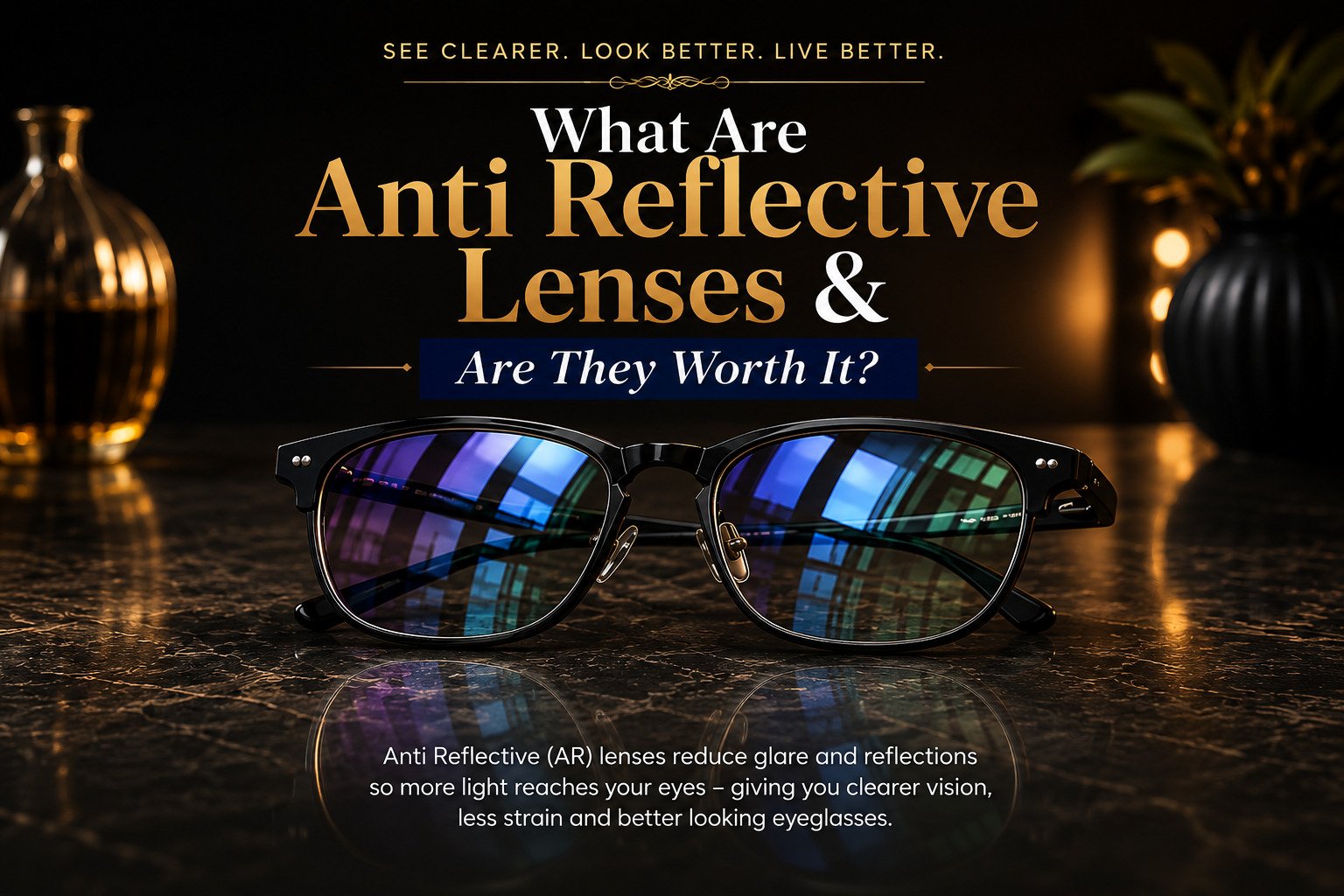
You have chosen the perfect frame. The prescription is right. The glasses fit beautifully. Yet every time you drive at night, sit under bright office lights, or take a photograph, there it is: glare dancing across your lenses.
That is exactly the problem anti-reflective lenses are designed to address.
Often called AR lenses, anti-reflective lenses use a special optical coating to reduce reflections from the surfaces of your eyeglass lenses. The result can be clearer vision, less distracting glare and glasses that look noticeably more transparent. (Zeiss)
But AR coating usually costs extra. So is it genuinely useful—or simply another upgrade being added to your bill?
For many eyeglass wearers, it is one of the lens upgrades most worth considering.
What Exactly Is an Anti-Reflective Lens?
Every ordinary eyeglass lens reflects some of the light that hits its surface.
Instead of all available light passing through the lens toward your eye, some is reflected away. You may notice this as bright white reflections, glare from lamps, headlights appearing across your lenses, or distracting reflections when someone looks at you.
An anti-reflective coating is made from very thin optical layers applied to the lens to suppress these reflections. Modern premium coatings can reduce reflections from both the front and back surfaces while allowing more light to pass through toward the eye.
Put simply:
Ordinary lens: more visible reflections
AR lens: less reflection and greater transparency
The difference can sometimes look surprisingly dramatic.
Why Do Reflections Matter?
Glare isn't merely cosmetic.
Imagine driving after dark. There are streetlights overhead, illuminated signs around you and headlights approaching from the opposite direction. Each light source has the potential to create distracting reflections on your glasses.
ZEISS specifically notes that lens reflections can be particularly troublesome on wet roads and while driving at night. (Zeiss)
AR coating doesn't magically turn night into daylight, nor should it be treated as a cure for every night-vision problem. What it can do is reduce reflections produced by the lenses themselves.
That distinction matters.
The Biggest Benefits of Anti-Reflective Lenses
1. Clearer, Less Distracting Vision
This is the main reason to buy them.
Reducing surface reflections allows more light through the lens and reduces visual interference caused by reflected light. Premium AR coatings are specifically designed to increase light transmission while reducing front- and back-surface reflections. (Zeiss)
The benefit can become especially noticeable under artificial lighting and in lower-light environments.
2. They Can Be Particularly Useful at Night
If you frequently drive after sunset, AR coating becomes much easier to justify.
Headlights and streetlights create exactly the type of bright point sources that can make lens reflections annoying. Some manufacturers even produce specialized driving lenses and coatings designed specifically around glare in nighttime driving conditions. (Zeiss)
Again, AR coating does not eliminate every source of glare. But reducing the reflections originating from your own lenses can make the visual experience more comfortable.
3. Your Glasses Look Better
This benefit gets underestimated.
Without AR coating, someone speaking to you may sometimes see the reflection of a window, lamp or computer monitor instead of seeing your eyes clearly.
With a good AR coating, the lenses can appear almost invisible.
That means the frame and your eyes become the focus—not reflections on the lenses. ZEISS similarly notes that reduced reflections make the eyes appear clearer and more natural through the glasses. (Zeiss)
For an attractive or unusual frame, that can make a substantial aesthetic difference.
They Are Also Better for Photographs and Video Calls
Anyone who wears glasses knows the problem.
You take a photograph and suddenly two enormous white reflections appear across your lenses.
Or you join a video call and your computer screen seems to be sitting on top of your eyes.
AR coating cannot guarantee reflection-free photography—lighting position still matters—but reducing lens reflections generally makes your eyes more visible.
For people who regularly attend video meetings, create content or simply dislike glare in photographs, this alone can be a compelling reason to choose AR.
Is Anti-Reflective the Same as Blue-Light Blocking?
No.
This is one of the most common misunderstandings.
Anti-reflective treatment and blue-light filtering are different optical functions.
Anti-reflective coating primarily addresses reflections from the lens surfaces.
Blue-light filtering technology is designed to reduce selected wavelengths of blue light.
A lens product can incorporate both technologies, but buying an AR coating does not automatically mean you are buying a blue-light filter. Manufacturers such as ZEISS offer conventional AR coatings as well as separate products incorporating blue-light-related technologies. (Zeiss)
So when ordering glasses, don't simply ask:
“Does this have coating?”
Ask which coating and what exactly it does.
What About the Green, Blue or Purple Reflection?
Here's something that initially confuses many people.
If AR lenses reduce reflections, why can you sometimes see a faint green, blue or purple reflection on them?
That subtle colour is called the residual reflection.
Different coating designs can leave different residual hues. Standard AR coatings are often associated with a greenish reflection, while some modern premium coatings use subtler blue or other residual colours. (Zeiss)
A faint residual colour therefore doesn't necessarily mean something is wrong with the lenses.
Are AR Lenses Harder to Keep Clean?
This depends heavily on coating quality.
Older or inexpensive coatings can sometimes make fingerprints and smudges frustratingly visible.
Modern premium AR systems, however, frequently combine the anti-reflective layers with additional treatments designed to resist water, oil, dust and smudging. Some also incorporate hard coatings to improve scratch resistance. (Zeiss)
This is why two opticians can both offer something called “anti-reflective coating” at very different prices.
They may not actually be equivalent products.
Cheap AR vs Premium AR: Does It Matter?
Yes.
Don't think of AR as a simple yes/no feature.
Quality can differ in:
- reflection reduction,
- scratch resistance,
- smudge resistance,
- water and oil repellency,
- durability,
- ease of cleaning,
- residual colour,
- and how well the coating adheres to the lens over time.
Premium coating systems may combine several functional layers rather than merely adding anti-reflection treatment. (Zeiss)
So if one optical shop offers AR for a tiny additional amount while another charges substantially more, ask for the coating manufacturer, product name, warranty and included properties before assuming they are selling the same thing.
Who Benefits Most From Anti-Reflective Lenses?
AR coating becomes particularly attractive if you:
Drive frequently at night
Reducing lens reflections can be valuable around headlights and streetlights.
Wear glasses throughout the day
A small improvement becomes much more meaningful when you experience it for 10 or 12 hours every day.
Work under bright artificial lighting
Offices, shops and studios can contain numerous potential reflection sources.
Spend significant time on video calls
Less reflection can make your eyes more visible on camera.
Wear high-index lenses
Discuss AR with your optician when choosing lens material and index, since lens material and coating should be considered together.
Care about how your glasses look
A beautiful frame generally looks better when reflections aren't hiding your eyes.
Who Might Not Need Them?
Not everybody needs to spend extra.
If the glasses are an inexpensive emergency backup pair that you rarely wear, premium AR may not represent particularly good value.
Similarly, if your budget forces a choice between an essential prescription/lens requirement and a premium cosmetic coating, get the fundamentals right first.
Correct prescription, appropriate lens design, accurate measurements and proper frame fit matter more.
AR should enhance a good pair of glasses—not compensate for a bad one.
How Should You Care for AR-Coated Lenses?
Good lenses deserve good cleaning habits.
Rinse away dust and particles rather than aggressively rubbing a dirty lens. Use products intended for eyeglasses and a clean microfiber cloth, and follow the coating manufacturer's care instructions.
Also remember that anti-reflective does not mean scratch-proof. Some modern coating packages add substantial scratch resistance, but that is not permission to throw your glasses lens-down onto a table. (Zeiss)
A case is still considerably cheaper than replacement lenses.
So, Are Anti-Reflective Lenses Worth It?
For someone who wears glasses regularly, in many cases, yes.
AR coating addresses something fundamental to eyeglasses: unwanted light reflecting from the very lenses that are supposed to help you see.
It can make lenses more transparent, reduce distracting reflections, improve their appearance and offer particular advantages in challenging lighting conditions. Premium coating packages may add useful durability and easier-cleaning properties as well. (Zeiss)
But don't buy AR simply because an optician says, “It's better.”
Ask what you are actually getting.
A good question at the counter is:
“Which anti-reflective coating is this, what additional properties does it include, and what warranty does the coating have?”
That one question can tell you far more than the words “AR included.”
The Bottom Line
A great frame gets noticed.
A great lens almost disappears.
And that is perhaps the best way to understand anti-reflective lenses: the less you notice the lens, the more freely you can enjoy everything beyond it.