
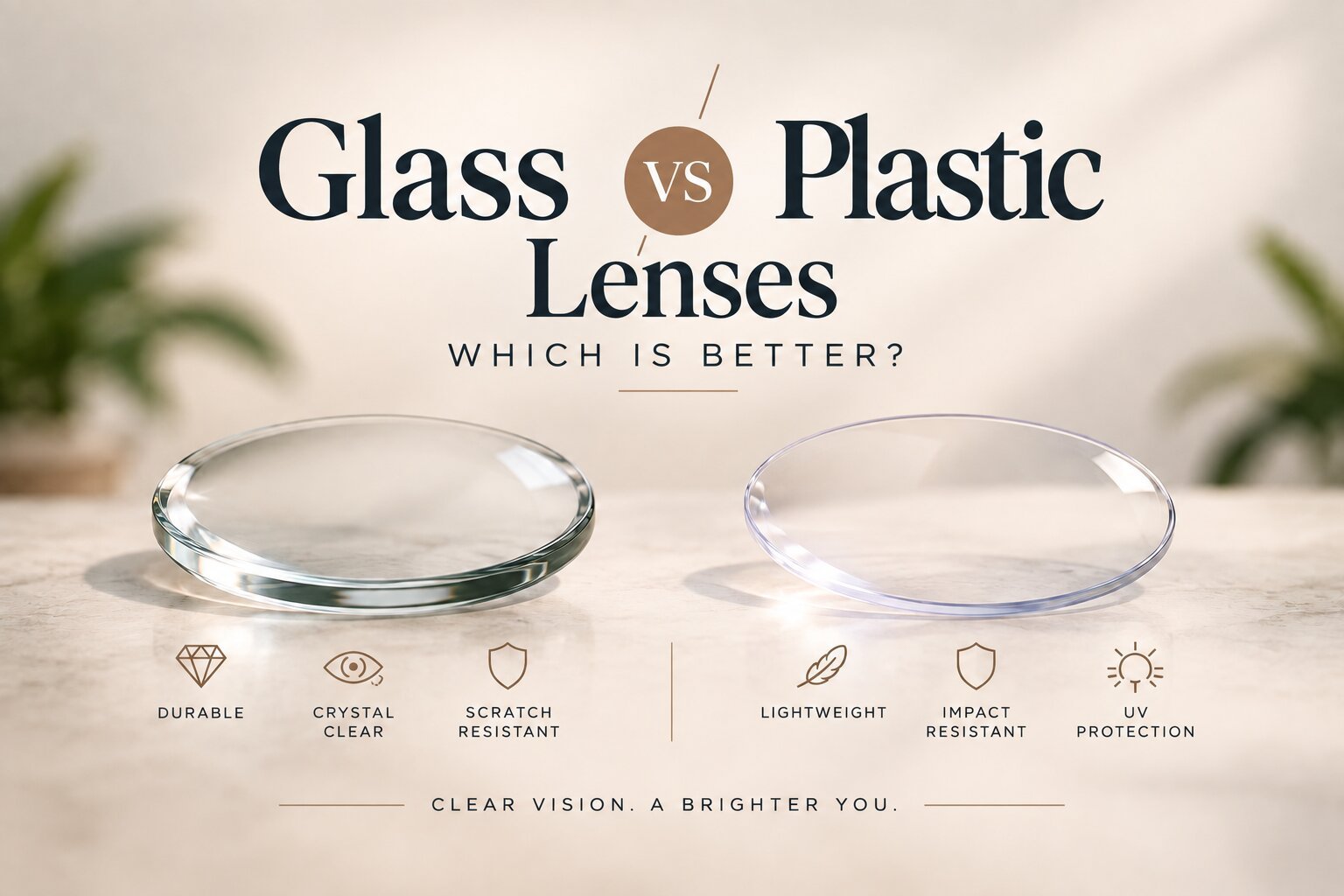
Choosing the right eyeglass lenses is just as important as choosing the right frame. A beautiful pair of glasses may define your style, but the lenses determine how clearly, comfortably, and safely you see through them every day.
For decades, glass lenses were considered the standard. Today, however, plastic lenses dominate modern eyewear because they are lighter, safer, and available in a much wider range of prescriptions and coatings.
So which one is actually better?
The answer depends on how you wear your glasses, your prescription, your frame, and what matters most to you.
Glass Lenses: The Traditional Choice
Glass has a long history in optics. Before modern lens materials became widely available, most prescription spectacles were fitted with mineral glass lenses.
One of the main strengths of glass is its excellent resistance to everyday scratching. Even without sophisticated coatings, glass generally handles surface abrasion better than untreated plastic.
Glass lenses can also provide excellent optical quality. High-quality mineral lenses can offer crisp vision with relatively low chromatic distortion.
But there is a significant trade-off: weight.
Glass is substantially heavier than most modern plastic lens materials. In a large or oversized frame, this difference becomes even more noticeable. Strong prescriptions may also result in thicker, heavier lenses.
Glass is also more brittle. Although modern glass lenses can be treated for increased strength, they are still more likely to crack or shatter under a strong impact than plastic lenses.
For this reason, glass is rarely the first choice for children, sports eyewear, active lifestyles, or situations where impact resistance matters.
Plastic Lenses: The Modern Standard
When people hear "plastic lenses," they sometimes imagine something cheap or less precise than glass. Modern optical lenses are very different.
Materials such as CR-39, polycarbonate, Trivex, and high-index plastics are specifically engineered for eyewear.
Their biggest advantage is weight.
A plastic lens can be dramatically lighter than an equivalent glass lens, making glasses more comfortable for long periods of wear. This is particularly valuable with oversized frames and stronger prescriptions.
Plastic lenses are also much more impact resistant.
Polycarbonate and Trivex are especially strong, which is why they are commonly used for children's eyewear, safety glasses, sports eyewear, and rimless designs.
Modern plastic lenses can also be combined with advanced treatments including:
anti-reflective coatings
UV protection
scratch-resistant coatings
photochromic technology
blue-light filtering options
polarization
tints and gradient colours
This versatility is one of the reasons plastic has become the dominant material in modern optical dispensing.
What About Scratches?
This is one area where glass traditionally performs extremely well.
Plastic is naturally softer and can scratch more easily. However, modern hard coatings have greatly reduced this disadvantage.
A high-quality plastic lens with a good scratch-resistant coating can perform very well in everyday use.
That said, no lens is completely scratch-proof. Proper cleaning still matters.
Using a microfiber cloth, rinsing dust away before wiping, and avoiding tissues or clothing can significantly extend the life of any lens.
Which Is Better for Strong Prescriptions?
This is where modern plastics become particularly interesting.
High-index plastic lenses are designed to bend light more efficiently than standard plastic. This allows strong prescriptions to be made thinner and lighter.
For someone with a high prescription, this can make an enormous difference in comfort and appearance.
Instead of a thick, heavy lens dominating the frame, a properly selected high-index lens can create a much cleaner result.
Glass also comes in higher-index forms, but weight and safety considerations mean plastic is often the more practical solution.
And What About Vintage Frames?
This question becomes especially important when fitting prescription lenses into vintage eyewear.
Older frames were created in an era when lens materials, shapes, and fitting techniques were different. Some frames are delicate, rare, or simply too valuable to subject to unnecessary stress.
Heavy glass lenses can place additional pressure on vintage hinges, bridges, and frame rims.
For many vintage frames, a carefully selected plastic or high-index lens provides a better balance of optical performance, weight, and preservation.
The goal should never simply be to put a prescription into an old frame.
The goal is to respect the frame while making it wearable again.
That means considering the frame material, age, construction, lens shape, prescription strength, and intended use before choosing the lens.
So Which Should You Choose?
For most people today, high-quality plastic lenses are the more practical choice.
They are lighter, safer, highly customizable, and suitable for almost every prescription.
Glass still has advantages. Its natural scratch resistance and optical characteristics continue to appeal to some wearers, particularly those who value traditional lens materials and do not mind the additional weight.
But there is no universal "best lens."
The best lens is the one that works with your prescription, your frame, and the way you live.
A Frame Has Character. The Lens Gives It Purpose.
At TheEyewearArchive, we believe eyewear should combine design, history, and function.
A vintage frame may have survived for decades because of its craftsmanship and character. With the right prescription lenses, it does not have to remain simply a collectible.
It can become part of someone's everyday life again.
Whether you choose traditional glass or modern plastic, good eyewear begins with one principle:
Choose the lens as carefully as you choose the frame.